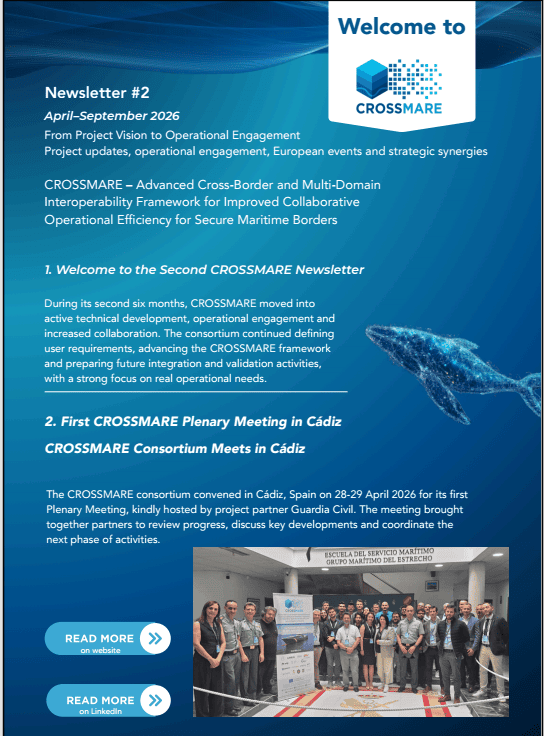
The 2nd CROSSMARE Newsletter is now available, covering the project’s progress and activities from April to September 2026.
During this period, CROSSMARE moved further from project development towards operational engagement, European collaboration and preparation for real-world validation. The consortium continued advancing the CROSSMARE framework while placing the needs of operational end-users at the centre of its activities.
Highlights from the second semester
One of the key milestones was the first CROSSMARE Plenary Meeting in Cádiz, Spain, hosted by project partner Guardia Civil on 28–29 April 2026. The meeting brought together project partners to review progress, discuss key developments and coordinate the next phase of activities. A dedicated Guardia Civil workshop also provided an important operational perspective on the requirements for effective security technologies.
CROSSMARE also strengthened its presence within the European security and research community, participating in events including CERIS Projects to Policy Seminar 2026 in Brussels, SICUR 2026 in Madrid, RISE-SD 2026 in Varna, and the 9th Summer Course on Intelligence and Security at the University of La Rioja.
Building European synergies
During this period, CROSSMARE expanded its collaboration with related Horizon Europe projects, including MARCONNECT, AI4COPSEC, COLOSSUS, THEIA and ORBIS. These synergies support knowledge exchange, stakeholder engagement and collaboration around maritime situational awareness, artificial intelligence, unmanned systems, Earth observation and interoperability.
Preparing for the CROSSMARE pilots
An important focus of the second semester was the preparation of the project’s validation activities.
CROSSMARE will progressively test and validate its technologies through four operational activities in Lithuania, Italy, Romania and Spain, moving from small-scale testing to a tabletop exercise and ultimately to a full-scale demonstration involving real assets, operational end-users and relevant stakeholders.
The validation activities will bring together technologies across space, air, surface and underwater domains, including HAPS, RPAS, UAVs, autonomous surface and underwater systems, satellite imagery, advanced sensors, AI, data fusion, C2 systems and CISE interoperability.
Growing the CROSSMARE community
CROSSMARE also continued strengthening engagement with key European stakeholders. During the reporting period, the project established initial contacts with Frontex and the European Maritime Safety Agency (EMSA), opening opportunities for future collaboration, visibility and uptake of CROSSMARE results.
Read the full CROSSMARE Newsletter #2 to discover the latest project developments, activities and the next steps towards the validation of CROSSMARE solutions.
Stay connected and follow the CROSSMARE journey towards secure, intelligent and interoperable maritime surveillance across Europe.